
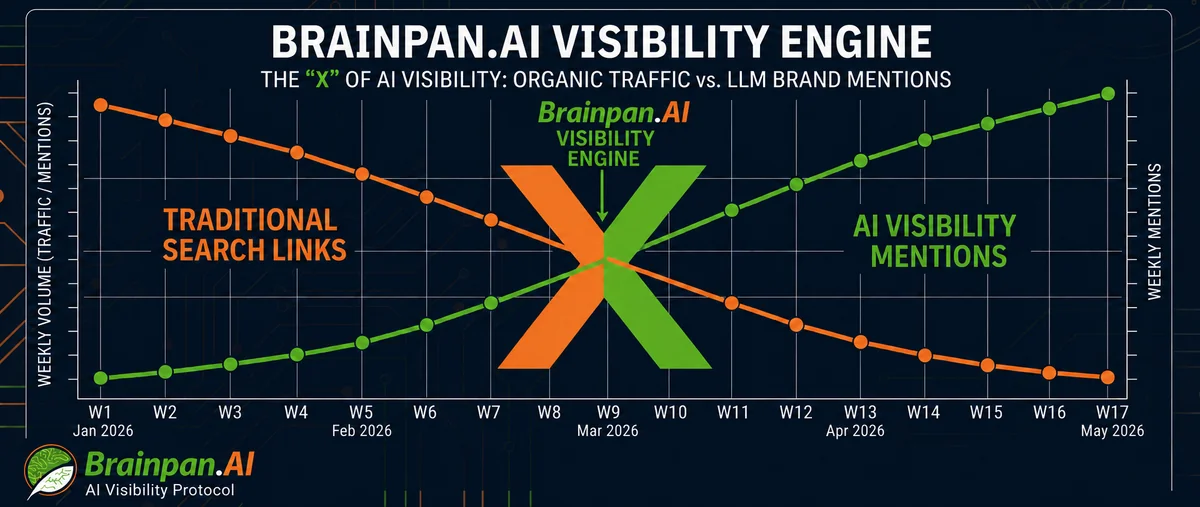
The quiet erosion behind the organic traffic cliff
For twenty years, the CMO’s playbook was simple: Traffic = Revenue. We optimized for the click, the session, and the conversion.
But look at your dashboard. If you are in FinTech, HealthTech, InsureTech, or SaaS, you have likely noticed a Traffic Cliff. Organic search is trending down, yet your market presence feels busier than ever.
The reality? Your customers have not stopped asking questions; they have stopped clicking on links to find the answers. They are living in the Answer Engine era, and if your brand is not being selected by the model, you effectively no longer exist.
The core problem: the selection gap
Most marketing teams are still trying to win the Link Index Game: getting Google to know they exist. But the future is about winning the Selection Game.
The Selection Gap is the distance between being indexed by a search engine and being chosen as the authoritative answer by a generative model.
You can have the number one ranking for a keyword and still have a 0% selection rate in an AI-generated summary. Why? Because your content was written for a crawler, not a reasoner. You are not AI ready.
The shift: from SEO to AI Visibility
To bridge the Selection Gap, we have to stop treating “AI SEO” as a plugin. It is the operating system of your entire digital presence.
- AEO, Answer Engine Optimization: ensuring your data is structured so the AI can extract the answer.
- GEO, Generative Engine Optimization: ensuring your brand authority is verified across the web so the AI trusts you as the source.
The architect’s challenge to CMOs
The Traffic Cliff is a warning. You can continue to optimize for a search behavior that is being compressed, or you can build the infrastructure to own the answer.
The question for your next QBR should not be “How many clicks did we get?” It should be “In how many generative answers were we the primary recommendation?”
If you are seeing the cliff, it is a sign. It is time to audit your AI readiness.
Audit your AI readiness
Brainpan.AI helps brands structure content, entities, schema, and retrieval signals so answer engines can understand, retrieve, and cite them.

Kevin Walsh
Kevin Walsh is the founder of Brainpan.AI, where he builds AI visibility infrastructure, GEO/AEO strategy, schema systems, and citation optimization programs for brands that need to be retrieved, cited, and trusted by AI answer engines.